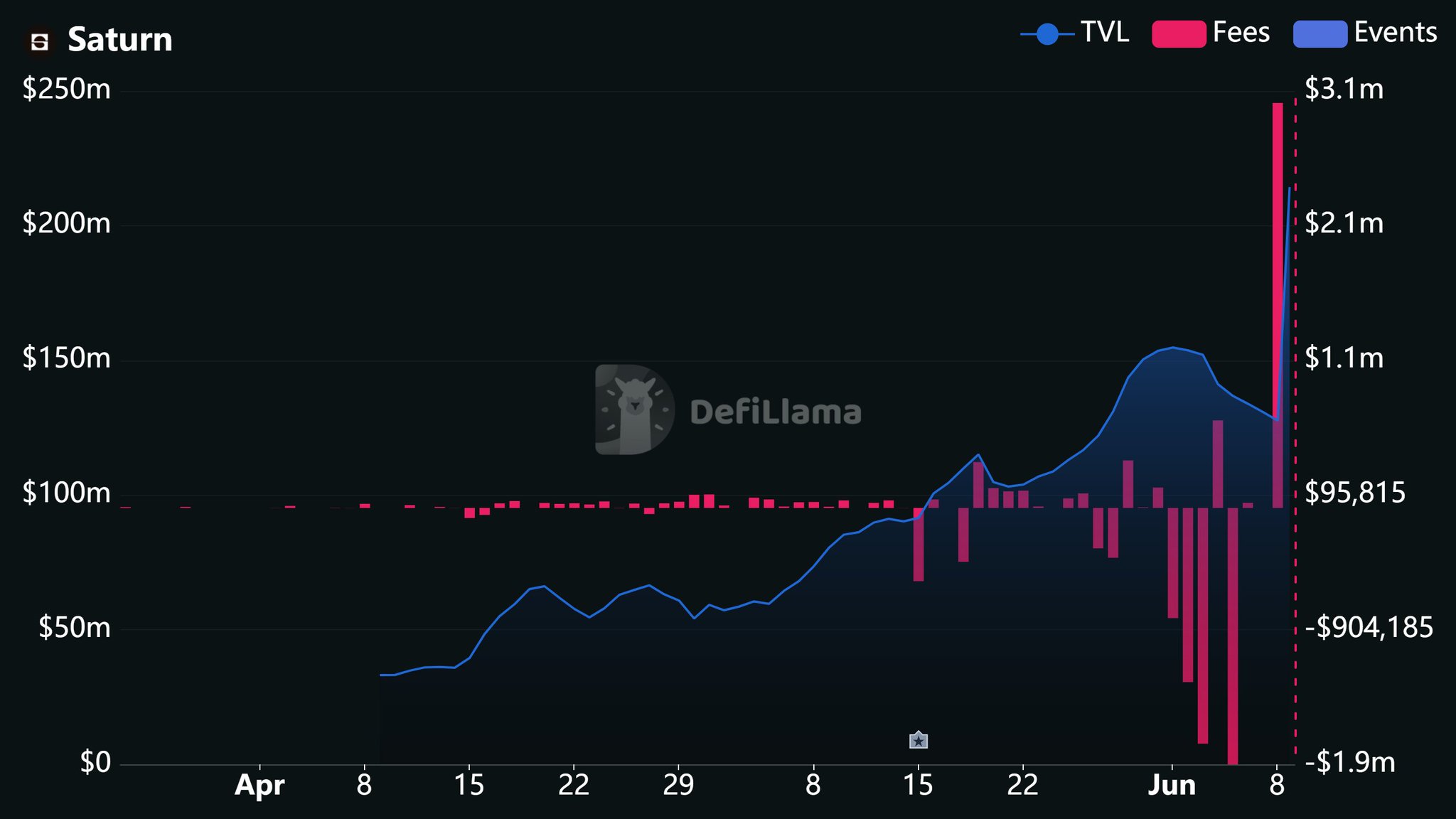
Saturn protocol fees hit a new high, primarily due to STRC asset revaluation rather than actual revenue.
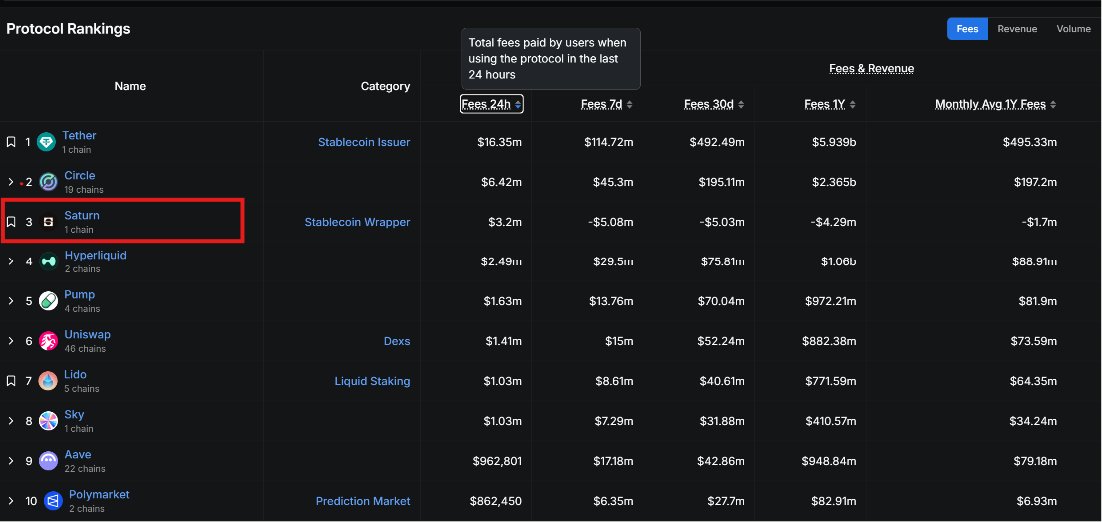
For the first time, @saturn_credit briefly flipped @HyperliquidX in daily fees.
Saturn recorded roughly $3.28 million in fees over 24 hours, marking a new high on the chart.
But the interesting part is what happened behind the scenes.
Saturn is a dual-token Bitcoin-backed credit protocol built around two assets:
• USDat: a non-yielding stablecoin backed by tokenized U.S. Treasuries and stablecoin reserves.
• sUSDat: the yield-bearing version. When users stake USDat, the protocol reallocates reserves toward digital-credit exposure, primarily Strategy’s STRC preferred stock.
When dividends accrue, sUSDat price goes up relative to USDat.
So, why did Saturn’s reported fees spike yesterday?
To understand that, it helps to look at how the sUSDat vault works.
At a high level, around 85% of the vault consists of STRC, which means two things can affect its valuation:
• Actual yield accrual from deposit fees and the yield generated by the assets held in the vault.
• Market revaluation when the price of STRC changes.
STRC trades on the market, which means its price can move from one day to another.
When the price rises, the value of the STRC held inside the sUSDat vault also increases. That mark-to-market gain is reflected in Saturn’s reported fees on @DefiLlama.
This matters because STRC is designed to trade close to its $100 stated amount.
Strategy can adjust the dividend rate periodically to encourage the price to move toward that level.
When STRC trades below $100, the dividend rate can be increased to make the asset more attractive to buyers.
When it trades above $100, the dividend rate can be reduced, which may gradually pull the premium back down.
Although this mechanism helps anchor STRC close to $100, its price does not remain fixed every day. And because the sUSDat vault holds a large amount of STRC, even a relatively small price movement can significantly affect its valuation.
At a high level, the revaluation component is calculated as: change in STRC price × STRC held in the vault
Yesterday, STRC moved up by around 3.45%.
That price movement increased the value of the STRC held inside the sUSDat vault and contributed significantly to the spike in reported fees.
This does not mean Saturn suddenly received $3.2 million in new deposits or generated an equivalent amount of recurring yield.
Part of the increase came from the market value of the vault’s STRC exposure moving upward.
So, what is the best way to track Saturn’s performance?
It depends on what you are trying to measure.
If the goal is to understand the total return experienced by sUSDat holders, the movement in the vault’s value matters.
But if the goal is to understand the protocol’s recurring earnings, revenue may be the more useful metric.
Despite the $3.2 million reported in daily fees, only around $51,000 accrued as protocol revenue.
There is also an interesting angle worth monitoring.
Because Strategy tries to anchor STRC close to $100, periods when the asset trades below or above that level may create opportunities.
If STRC falls below $95, it may be worth watching whether a higher dividend rate attracts buyers and pulls the price closer to par.
If STRC trades above $100, it may also be worth watching whether a lower dividend rate gradually reduces the premium.
These are not guaranteed trades but could be a useful framework for understanding how STRC price movements affect both sUSDat holders and Saturn’s headline fee numbers.
P.S. This is not financial advice. I was trying to understand the protocol more deeply, and this was one of the more interesting things I found.