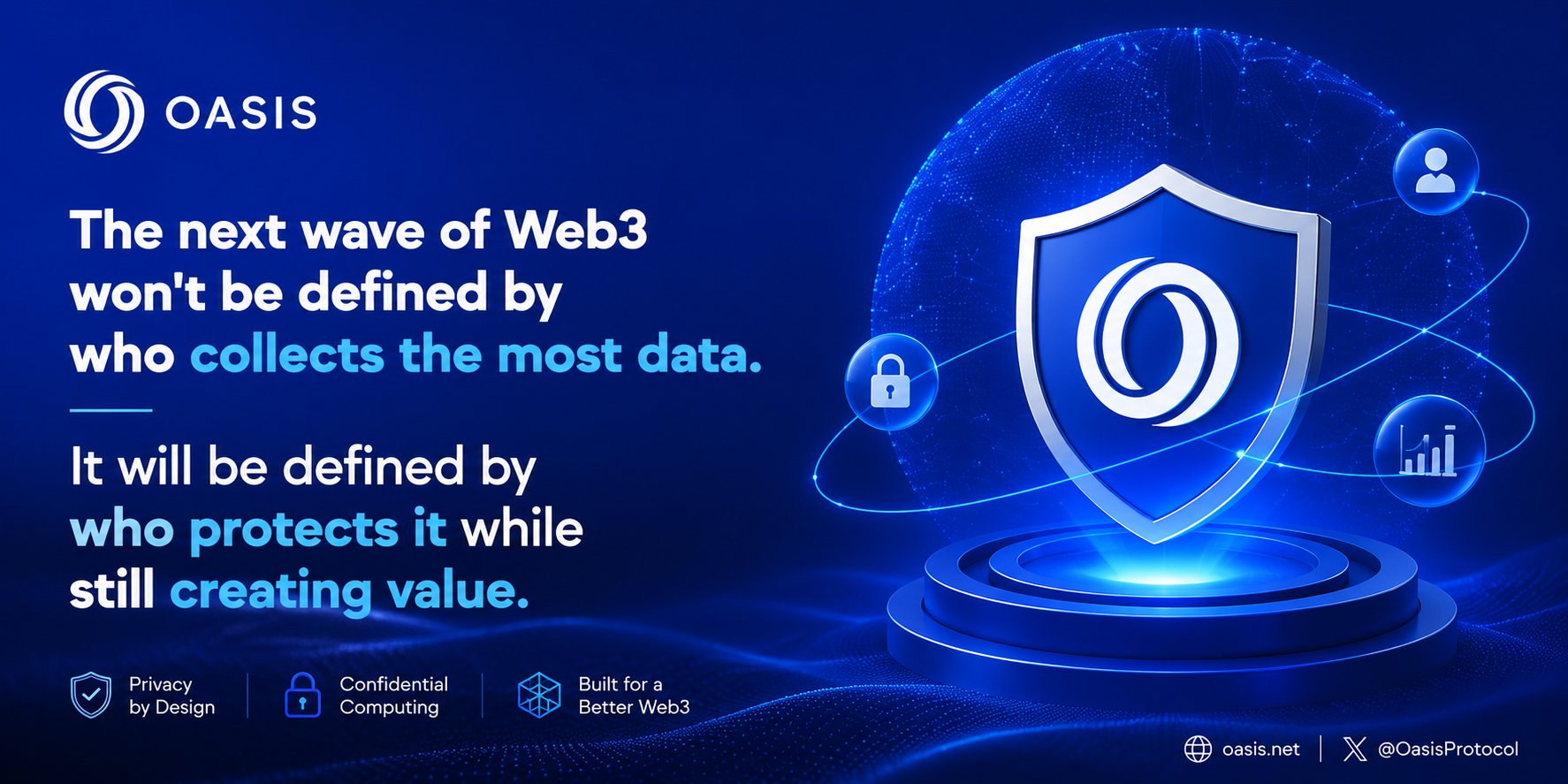
The next era of Web3 won't be defined by who collects the most data. It'll be defined by who gives people the most control over it.
@OasisProtocol https://t.co/ZXnMUS38pt

The next era of Web3 won't be defined by who collects the most data. It'll be defined by who gives people the most control over it.
@OasisProtocol https://t.co/ZXnMUS38pt
The internet has quietly trained us to believe that giving up privacy is the price of convenience. We've accepted it for years because there never seemed to be another option. But ownership loses its meaning the moment you lose control over your own information.
That's why I've been paying closer attention to @OasisProtocol. Their approach reminds me that privacy isn't about disappearing from the internet. It's about deciding what to reveal, when to reveal it, and who gets access. That shift changes everything for Web3.
As AI becomes a bigger part of our digital lives, trust becomes the real currency. People won't confidently use intelligent applications if every interaction means exposing more personal data. Privacy and transparency have to exist together, not compete with each other.
The strongest decentralized ecosystems will be the ones that respect users beyond wallet addresses. Giving people meaningful control over their data creates stronger communities, better applications, and a healthier foundation for innovation to grow.
That's one of the reasons I keep watching @OasisProtocol. Building technology that protects users while enabling developers to create smarter applications feels like the kind of long-term thinking Web3 needs. Adoption starts with trust, and trust starts with control.
Explore more on: https://t.co/8mLuzuyEEe
$ROSE #OasisProtocol
Privacy isn’t about hiding; it’s about having the agency to choose what you share. As we navigate the next phase of Web3, the projects that prioritize this fundamental human right are the ones that will define the infrastructure of tomorrow. Exploring the shift toward confidential computing and how we reclaim our data sovereignty.
The digital landscape is currently obsessed with speed and scale, but there is a quiet, more urgent conversation happening just beneath the surface: the tension between radical transparency and the need for genuine privacy.
For years, we’ve operated under the assumption that on-chain data must be completely public. But true mass adoption isn’t about making every single interaction visible to the world; it’s about giving users the autonomy to decide what stays private and what is shared. That is where @OasisProtocol enters the frame.
Instead of forcing a choice between utility and confidentiality, it introduces a way to compute data securely without exposing it. This isn’t just about protecting a wallet balance; it’s about enabling a new generation of decentralized applications, from credit scoring to private identity verification that wouldn't be possible if the underlying data were always public.
If we want Web3 to feel as intuitive and safe as the traditional web, we have to bridge that gap. By separating consensus from execution and leaning into confidential smart contracts, we are finally seeing the infrastructure catch up to the promise of a user‑centric internet.
The most exciting part of this evolution isn’t the tech itself, it’s the shift in how we think about ownership. It’s moving away from "public‑by‑default" toward "private‑by‑design."
Explore more: https://t.co/Oy8QAk1Ins #OasisProtocol $ROSE
How many X on altcoins do you need to break even?
@ProfesorTurkmen What will happen to altcoins? #Rose