BNB Dữ liệu giá trực tiếp
Giá BNB hôm nay là $ 562.86 (BNB/USD). Với vốn hóa thị trường là $ 75.86B USD. Khối lượng giao dịch 24 giờ là $ 20.98M USD, Biến động giá trong 24 giờ là -2.05%, Và lượng cung lưu hành là 134.78M BNB.
BNB BNB Lịch sử giá USD
Theo dõi giá của BNB hôm nay, 7 ngày, 30 ngày và 90 ngày
Kỳ
Thay đổi
Biến động (%)
Hôm nay
$ 11.83
-2.06%
7ngày
$ 26.64
-4.52%
30ngày
$ 97.70
-14.79%
90ngày
$ 62.64
-10.01%
Sở hữu BNB ngay
Mua và bán BNB dễ dàng và an toàn trên BitMart.
BNB Thông tin thị trường
$ 545.96 Biến động 24 giờ $ 581.18
Cao nhất từng ghi nhận
$ 1,371.80
Thấp nhất từng ghi nhận
$ 0.49
Biến động 24 giờ
-2.05%
Khối lượng 24 giờ
$ 20,975,761.20
Nguồn cung lưu hành
134.78M
BNB
Vốn hóa thị trường
$ 75.86B
Nguồn cung tối đa
134.78M
BNB
Vốn hóa thị trường đã pha loãng hoàn toàn
$ 75.86B
Giao dịch BNB
BNB X Insight
L1 active users are concentrated on BNB Chain, Solana, and Tron, with overall active addresses decreasing.
L1 blockchain monthly active users highlight growth and concentration! 🚨
• @BNBCHAIN leads with 41.2M monthly active addresses, showing sustained user adoption across DeFi and NFT ecosystems.
• @solana follows with 26.3M active users, continuing to capture activity in tokenized stocks and RWA trading.
• @trondao reports 19.4M monthly addresses, maintaining strong DeFi engagement.
• @ethereum remains key for smart contracts and lending protocols, with 8.1M active addresses.
User activity is concentrated on BNB Chain, Solana, and Tron, highlighting where adoption and liquidity are strongest.
2026-06-25 08:42
Xu hướng của BNB sau khi phát hành
Trung tính
L1 active users are concentrated on BNB Chain, Solana, and Tron, with overall active addresses decreasing.
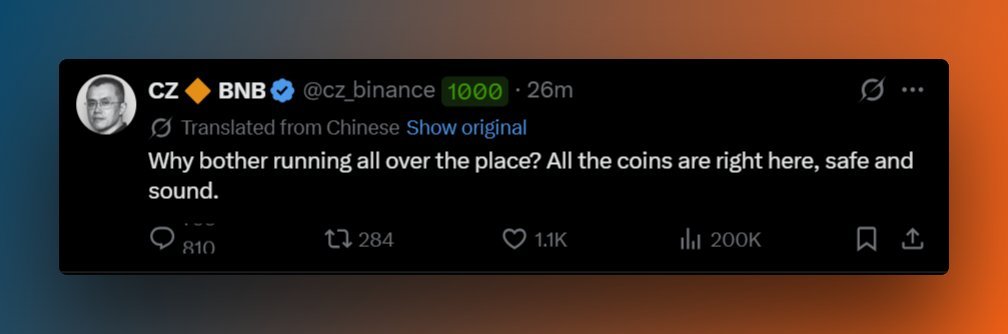
CZ is bullish on BNB and the long‑term growth of the overall crypto market, despite regulatory challenges.
Coindesk interview video full transcript with @cz_binance (50 minutes)
Jenn: Take me back to the moment you first realized that money mattered.
CZ: I realized it when I was very young. I grew up in a struggling family. My father lived on a student stipend and my mother earned minimum wage. We never went hungry and we had a roof over our heads, but many things were unaffordable.
The first quantitative understanding of money came when I was 14 and worked at McDonald’s. The hourly wage was CAD 4.5, below the minimum wage. At that time you learn how much time you need to exchange for a certain amount of money and what that money can buy. Every raise later made that feeling even clearer.
My father has always been frugal, and that habit passed to me. I think money is important, but you don’t need a lot of it to take care of yourself. After a certain threshold, money becomes just an amplifier for business. Beyond that, its importance diminishes.
Money is both a trading tool and a measure of value. It is crucial for the global economy to function, yet today the technology is still poor. This is something I have come to understand gradually throughout my career.
Jenn: My parents also emigrated to Canada and were very thrifty. They taught me to save and prepare for the future. To get where you are today, you have to break that survival‑mode mindset to some extent.
CZ: I come from an Asian family where my father always taught me to save. I have almost never been in debt in my life; the mortgage for my house is probably the biggest loan I have taken. I have never borrowed money to start a business. My sister gave me some money, friends and relatives have helped, but I have never taken high‑interest debt.
Every company I’m involved with has cash‑flow positivity at its core, allowing the business to be self‑sustaining. I never adopted a massive‑debt mindset. In the U.S. and most capital markets, debt is a powerful tool that can leverage rapid expansion, but I have never taken that path. This stems from my Asian cultural background.
My business philosophy is very capitalist: you need a sustainable business that provides value. Money is the incentive for people to deliver maximum value and also the engine of societal progress and innovation. So I blend both sides: my commercial practice leans U.S.‑style, but I avoid debt.
Jenn: I know your father spent five years alone in Canada before the family reunited.
CZ: He was indeed affected by the Cultural Revolution. He was supposed to go to university, but the schools were shut down. Later he immigrated to Canada on a student visa and eventually brought the whole family over.
Our experiences share similarities, but my situation is much better. I stand on his shoulders. He made huge sacrifices; I am a second‑generation immigrant. Watching your parents hustle passes on those values. I grew up in the West, worked in New York, Tokyo, and Singapore, and feel like an international citizen. He moved from one country to another and worked hard for his children.
My English isn’t great, but I moved to Canada at age 12 and grew up there. He only learned English in his thirties, which was even harder. We share common ground but also differ. I feel more like a global citizen.
Jenn: Your book is titled “Freedom of Money.” Finance has always been built on the foundation of financial freedom. Do you think people today have financial freedom?
CZ: Those are two different concepts. I define financial freedom as having enough money to do whatever you want without sacrificing your lifestyle. A modest lifestyle reaches that quickly; a lavish one takes longer.
Monetary freedom is entirely different. It asks: regardless of how much you have, can you freely spend it, transfer it, receive it, or invest it in whatever you want, and are those investment opportunities open to you?
In the U.S., most people have access to the stock market—roughly 60‑80 % of Americans invest in equities, and much of their wealth comes from stocks. In Asia and Africa those numbers don’t hold. People lack access to the same financial tools, get trapped in low‑pay jobs, and have little hope of improvement.
Providing these people with the ability to connect to the financial system is far more important. All you need is a smartphone and internet to reach an entire suite of financial tools that were previously unavailable. Having free, direct control over your money is more critical than financial freedom itself.
Jenn: You said you want to spend more time in the U.S., but it sounds like there are many gaps outside the U.S. that need filling. Why choose the U.S.?
CZ: There are several angles. First, from a global perspective, the U.S. is an incredibly influential decision‑maker. Whatever policy the U.S. adopts, the world tends to follow. The previous administration was anti‑crypto; the current one is pro‑crypto and aims to become a crypto capital—a very positive signal. That positive ripple has already spread globally: the U.S. passed the GENIUS Act, Hong Kong passed a stablecoin law, and other countries are catching up.
Second, even in the U.S. money isn’t completely free. High taxes and many policies make moving money from the U.S. to China difficult, and vice versa. The cost for U.S. consumers to engage with crypto is still high. Even here about 40 % of people don’t have a bank account. In the world’s most developed economies, a large population still lacks access to decent financial systems.
Getting access is only the starting point. How do we make the system cheaper, faster, more user‑friendly, and safer? AI is arriving now—AI can help us search for flight tickets, but it can’t yet place the order. AI can’t trade yet, but that’s coming soon. The financial system must open to AI agents.
Third, my personal and BNB ecosystem have deliberately avoided the U.S. for years, leading to many misconceptions. I think we need to invest time and capital in the U.S. We’ve invested heavily in startups and founders within the ecosystem.
I want to help the U.S. become a crypto capital and bring more crypto services to U.S. consumers. Binance is the world’s largest exchange, yet U.S. consumers don’t get the best liquidity. That’s an exception in crypto: in traditional markets—stocks, futures, even Amazon—U.S. consumers usually enjoy the best prices. Crypto lacks that, which hurts U.S. consumers and could be easily solved.
Jenn: You mentioned before dealing with the U.S. Department of Justice, that some U.S. exchanges may have lobbied regulators against you. Do you still feel that pressure?
CZ: Let me correct something— the DOJ has never sued me. I did plead guilty, which is a different matter.
Back then, there were indeed U.S. crypto platforms spreading negative rumors about us. I can’t verify every claim 100 %, but the feedback I received strongly suggests it was true. Even today I still hear many U.S. crypto firms are afraid of Binance entering the U.S.
Binance.US continues to operate in the U.S.; it never entered a DOJ guilty‑plea agreement. It once had a lawsuit with the SEC. At that time Gary Gensler’s SEC called BNB a security. After the new administration took office, that case was permanently dismissed, meaning the same lawsuit can’t be filed again.
U.S. consumers are paying too much for crypto. I heard the people behind the push were SBF and FTX. They’re gone now. Some other U.S. exchanges occasionally make minor moves. I respect competition, but using policy and regulatory pressure to unfairly suppress a rival harms consumers.
Jenn: The previous administration chased you relentlessly; the current one pardoned you. After all that, has your trust in the country or its government been shaken?
CZ: Yes. I lost a lot of trust. At the time I wanted to get as far away from the U.S. as possible. About a year and a half ago you asked me if I would come here for an interview—I said no. I didn’t want to be remembered or seen; I wanted to stay as far away as possible.
But that made me realize the U.S. Constitution is actually a brilliant white paper. It creates a framework that lets the country self‑adjust and self‑repair. If it goes off course or becomes extreme, there are built‑in correction mechanisms. That’s important.
So I’m grateful to the current U.S. administration. Even though I’ve been hurt, I now see that the nation can correct itself. That also explains why the U.S. is the global economic and military leader and why its policies influence the world.
I hold no grudges.
...
"I lost a lot of trust."
In this episode of @CoinDesk Spotlight, @cz_binance joins @JennSanasie to reflect on Binance, his return to the U.S., and the lessons he learned when everything changed.
00:00 Welcome to CoinDesk Spotlight
00:20 When CZ First Realized Money Mattered
03:08 A Frugal Mindset and Why He Never Took On Debt
04:35 His Father's Journey to Canada
06:30 Freedom of Money vs. Financial Freedom
08:28 Why CZ Wants to Spend More Time in the U.S.
11:52 Binance, U.S. Rivals, and Regulatory Pressure
14:39 Losing Trust - and Why the U.S. Constitution Is a "Great White Paper"
17:17 The Next Administration and the CLARITY Act
19:11 Reflecting on 2022: Was Crypto Too "Drunk" on Hype?
21:36 How AI and Crypto Are Merging
25:17 Crypto's 2026 Challenges
28:03 Inside CZ's Four Months in Prison
31:18 Why CZ Donated $2M to Prison Reform
32:57 What Inmates and Guards Asked Him About Crypto
36:26 Writing His Book: "A Conversation With Myself"
39:15 The Weaknesses and Strengths Prison Revealed
41:17 CZ's Advice to
2026-06-25 07:37
Xu hướng của BNB sau khi phát hành
Tăng giá
CZ is bullish on BNB and the long‑term growth of the overall crypto market, despite regulatory challenges.
Binance has withdrawn its MiCA licence application, facing EU market service restrictions, and recommends users to move their funds.
Binance Has Withdrawn Its MiCA Licence Application In Greece. From 1 July 2026, It Has No Legal Authorisation To Serve EU Clients.
If You Are In The EU, Do Not Wait. Move Funds To Self Custody Or A MiCA Licensed Exchange Before 1 July. Official Binance Update Due Before 30 June. https://t.co/arAX4qrefV
2026-06-25 03:37
Xu hướng của BNB sau khi phát hành
Giảm giá
Binance has withdrawn its MiCA licence application, facing EU market service restrictions, and recommends users to move their funds.
Dự đoán giá
Thời điểm phù hợp để mua BNB là khi nào? Liệu tôi nên mua hay bán BNB bây giờ?
Khi quyết định xem đây có phải là thời điểm tốt để mua hoặc bán BNB (BNB) hay không, điều quan trọng trước tiên là phải phù hợp với chiến lược giao dịch và mức độ chấp nhận rủi ro của riêng bạn. Các nhà đầu tư dài hạn và các nhà giao dịch ngắn hạn thường diễn giải điều kiện thị trường theo các cách khác nhau, vì vậy quyết định của bạn nên phản ánh cách tiếp cận cá nhân. Theo phân tích kỹ thuật 4 giờ mới nhất của BNB, tín hiệu giao dịch hiện tại là Hold. Theo phân tích kỹ thuật 1 ngày mới nhất của BNB, tín hiệu hiện tại là Hold.
Dự đoán Beacon
Dự báo giá xác suất cho (24 giờ tới)Tuyên bố miễn trừ trách nhiệm về dự đoán Beacon
Kết quả dữ liệu hiển thị trên trang này được phân tích dựa trên dữ liệu giao dịch thực tế (OHLCV) của cặp giao dịch đã chọn cùng với các chỉ báo kỹ thuật tương ứng.
Dự đoán này là một sản phẩm kỹ thuật thử nghiệm và chỉ được cung cấp để tham khảo. Đây không phải là lời khuyên đầu tư. Những sự kiện bất ngờ trong thế giới thực có thể tác động đáng kể đến hành vi thị trường. Các nhà giao dịch nên đưa ra quyết định một cách thận trọng.
Giới thiệu BNB
BNB (BNB) is a cryptocurrency . BNB has a current supply of 134,783,378.23000002. The last known price of BNB is 593.79344971 USD and is up 0.79 over the last 24 hours. It is currently trading on 3281 active market(s) with $799,674,578.40 traded over the last 24 hours. More information can be found at https://bnbchain.org/en.
Đọc thêm
Trình khám phá chuỗi
Khám phá thêm
BM Discovery
Mới niêm yết
SQQQON ProShares UltraPro Short QQQ
-- 0.00%
IBITON iShares Bitcoin Trust ETF
-- 0.00%
AMCON AMC Entertainment Holdings
-- 0.00%
GRABON Grab Holdings
-- 0.00%
SNAPON Snap(Ondo)
-- 0.00%
NES Nesa
-- 0.00%
HIVEON HIVE Digital Technologies
-- 0.00%
SOXSON Direxion Daily Semi Bear 3X ETF
-- 0.00%
TON AT&T Tokenized Stock (Ondo)
-- 0.00%
KEELON Keel Infrastructure
-- 0.00%
Mua BNB
Giao dịch BNB